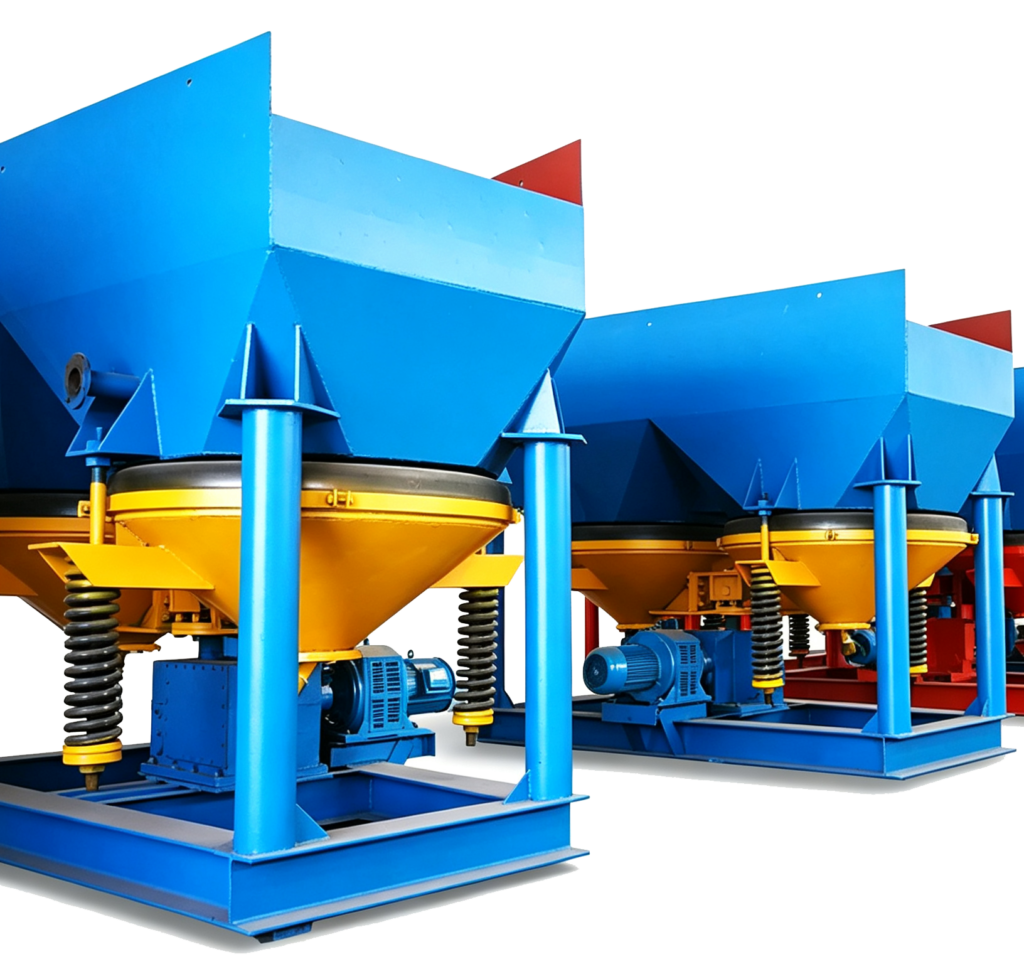
Jig Concentrator
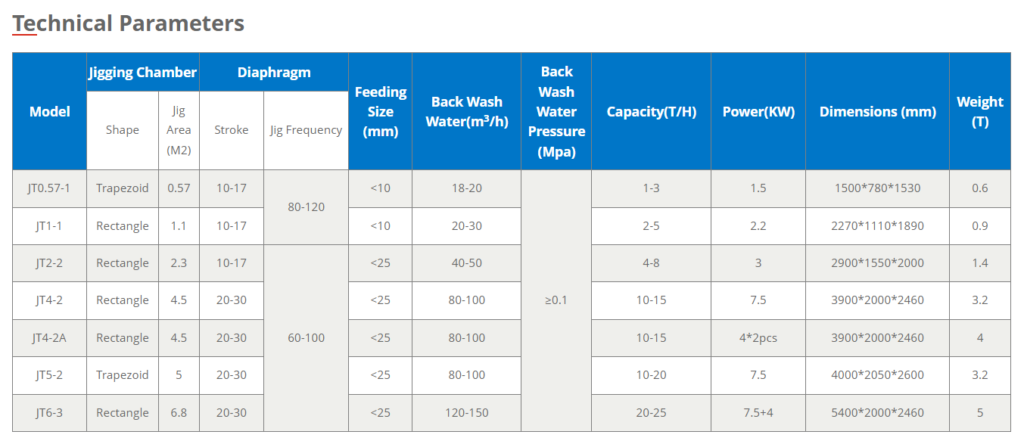
【Processing Capacity】1–25 tons/hour
Feed Particle Size: <25 mm
Types: Wet separation, dry separation
The jig concentrator is a gravity separation device used to process coarse-grained ores such as alluvial gold, placer gold, tantalum-niobium, tin, tungsten, diamond, barite, iron, manganese, fluorite, and garnet. Service Support: Customization, on-site installation, one-year warranty; process flow design and optimization.
Advantages
【Jig Concentrator】A device that utilizes the density difference between minerals for effective gravity separation.
Jigs are primarily used to process ores such as placer gold, tantalum-niobium, tungsten, and tin. The greater the density difference, the better the separation performance. 【Types】Eccentric jigs (plunger-type and diaphragm-type), hydraulic jigs, movable-sieve jigs, pneumatic pulsating jigs, and trapezoidal jigs. Diaphragm jigs offer high separation efficiency and handle coarse-grained ores, separating minerals like tungsten and tin within a particle size range of 0.5 mm to 16 mm.
Trapezoidal jigs feature high processing capacity and a wide particle size range (50–0.25 mm); they are widely used in tungsten, tin, and iron processing plants. Based on the separation medium, mineral jigs are categorized into hydraulic jigs and dry jigs (dry feeding yields better results).
【Features】Saw-tooth jigs use water as the medium; they offer high recovery rates for fine gold, low water consumption, and continuous operation.
【Related Equipment】Upstream: Feeding via belt conveyor, slurry pump, or gravity flow based on elevation difference. Downstream: Gold concentrate → shaking table; tailings → sluice box.
【Jig Manufacturer】Provides various types of mineral jigging equipment (e.g., stationary and mobile jigs) with parameters customizable to your specific requirements. Specializing in gravity separation technology for decades, our product range includes spiral chutes, jigs (mineral jig separators), shaking tables, and centrifugal concentrators.
[Jig Separator Working Principle] A mixture of mineral particles with varying specific gravities undergoes stratification based on density within a vertically moving, variable-speed medium flow (water or air). Lighter particles settle in the upper layer while heavier particles settle in the lower layer; mechanical action and water flow then separate these into products of different densities for individual discharge.
[Ragging Bed] A ragging bed (artificial bed) typically 10–15 cm thick, composed of 50% grade iron ore, is usually employed. Before delivery, JXSC engineers assist in determining the bed thickness, iron ore particle size, and screen mesh size, as well as adjusting the stroke length and frequency.
[Factors Affecting Jig Separation]
(1) Stroke length and frequency. These parameters determine the velocity, acceleration, and degree of looseness of the material bed within the jig. A long stroke with low frequency is better suited for coarse materials, whereas a short stroke with high frequency is more suitable for fine materials.
(2) Water consumption. Higher water flow rates accelerate the discharge of light materials and increase processing capacity; however, stratification may be incomplete, leading to light materials mixing with heavier ones.
(3) Material bed thickness. A thicker bed requires more time for stratification and separation.
With a thick bed, the quality of the heavy fraction improves while that of the light fraction declines; conversely, with a thin bed, the quality of the heavy fraction drops while that of the light fraction improves.
(4) Jig screen dimensions, aperture size and shape, and feed rate and uniformity.