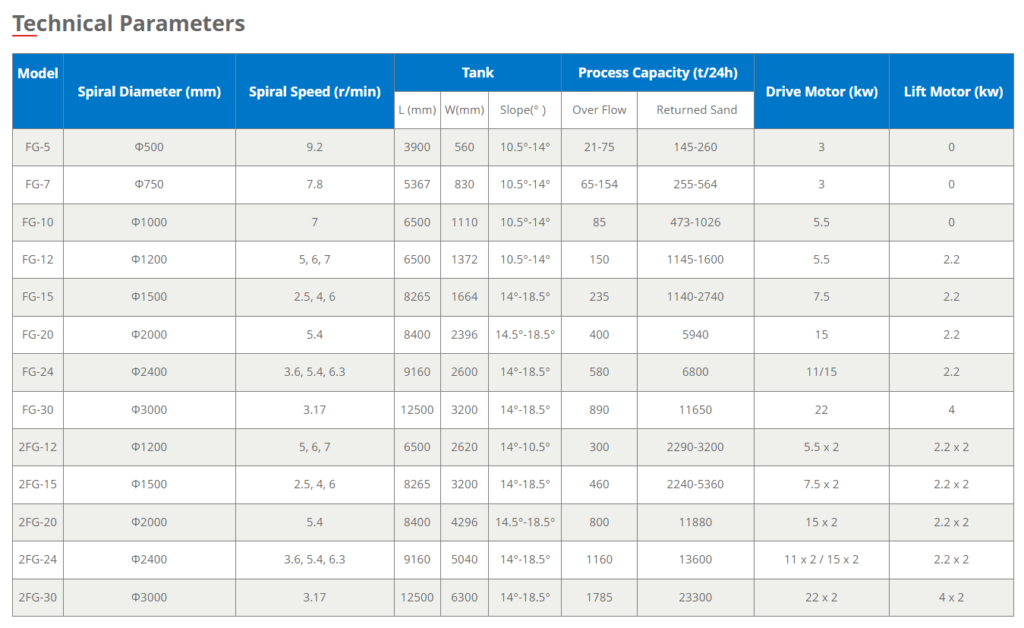
【Capacity】21–1,785 tons/day
【Motor Power】3–44 kW
【Spiral Diameter】500–3,000 mm
【Processable Materials】Natural sand, manufactured sand, and crushed sand.
【Applications】Used for cleaning mud and water, or in conjunction with ball mills to control material particle size.
Advantages
Spiral classifiers are available with spiral diameters up to 120 inches. They come in three models—featuring spiral submersion depths of 100%, 125%, and 150%—and are equipped with straight-sided tanks, modified flared tanks, or fully flared tanks.
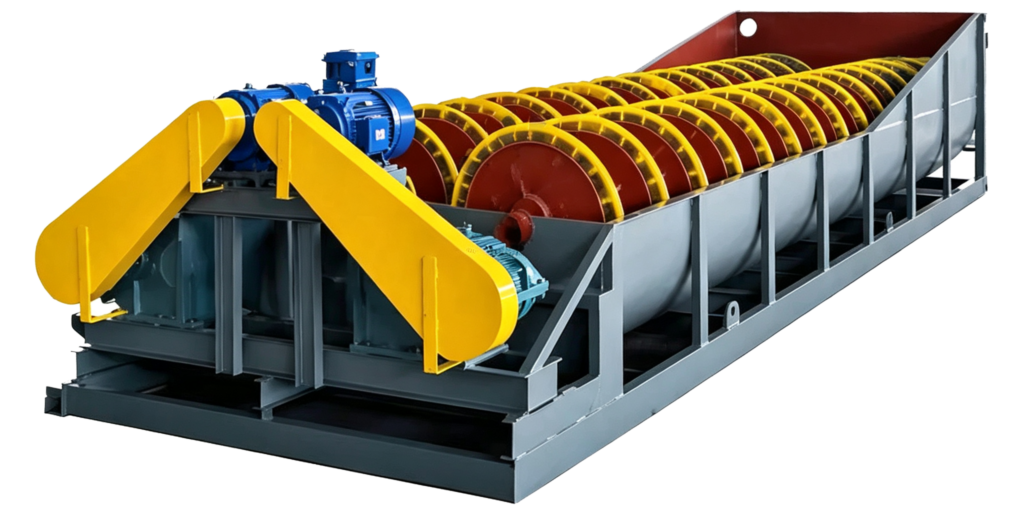
The spiral classifier is a common piece of particle-size classification equipment in the mining industry. It operates based on the principle that solid particles settle at different speeds in a liquid due to differences in specific gravity. The equipment filters the powder produced by the mill, uses spiral blades to convey coarse material back to the mill’s feed inlet, and discharges the filtered fine material through the overflow outlet. Spiral classifiers are often simply referred to as “classifiers.” There are four main types: high-weir single and double spiral, and submerged single and double spiral. The classifier primarily consists of a drive unit, spiral assembly, tank body, lifting mechanism, lower bearing (bushing), and discharge valve. Spiral classifiers are widely used in mineral processing plants to form a closed-circuit system with ball mills for separating ore streams; in gravity separation plants for classifying ore sands and fine slimes; and in metal beneficiation processes for classifying pulp, as well as for washing and dewatering operations in desliming hoppers.
Spiral Classifier Features
: 1. Low energy consumption;
2. Heavy-duty construction with a long service life;
3. Robust, independent spiral lifting mechanism;
4. Continuous spiral raking action;
5. High classification efficiency;
6. Wide range of weir height options;
7. Rigid tank and base structure;
8. Diverse tank design options;
9. Suitable for a wide range of industries. The spiral classifier operates on the principle that solid particles of varying sizes and specific gravities settle at different rates in a liquid medium; fine mineral particles remain suspended and flow out via the overflow, while coarse particles settle to the bottom. Material enters the classification equipment after being ground into powder; the spiral blades convey coarse material back to the grinding mill’s feed inlet, while fine material is discharged through the overflow pipe. The machine base is constructed by welding a channel steel frame with steel plating. The spiral shaft head is made of cast iron, ensuring wear resistance and durability, and the lifting mechanism is available in either electric or manual configurations. The main types of spiral classifiers include high-weir (single and double spiral), low-weir (single and double spiral), and submerged (single and double spiral) models, with high-weir, submerged, and XL-type classifiers being the most common.